
Eco-ThermaEco-Therma
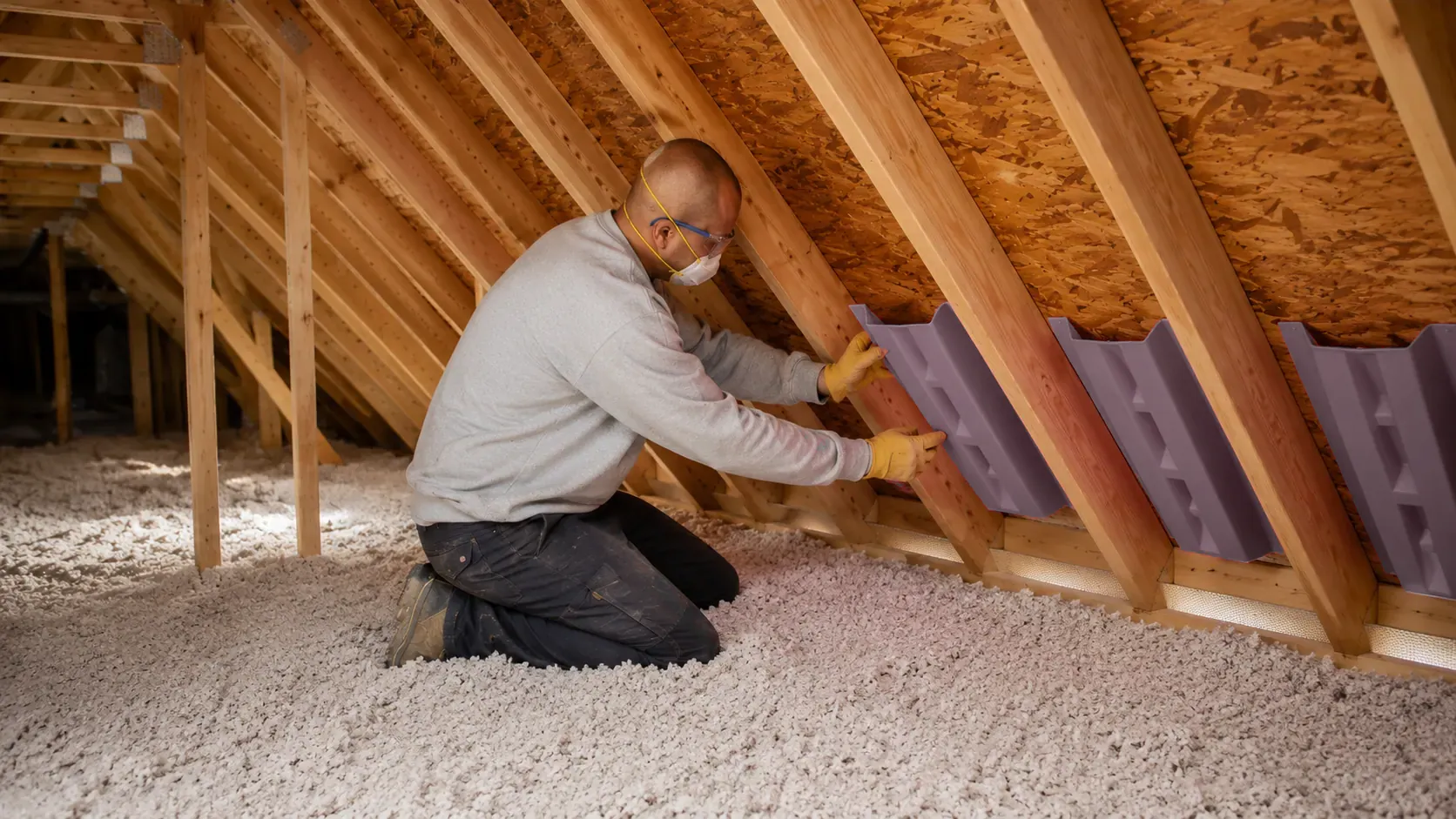
Loose blown insulation covering an attic floor between the ceiling joists

Resources

What R-value promises and what an attic delivers

Cellulose, fiberglass, foam and batts do not fail in the same ways, and the attic is what decides which one matters.

The short answer

R-value measures how well a material resists heat flow.It is measured on a flat, dry, evenly installed sample.An attic is none of those things.

That gap is the subject of this guide. Two attics finished with the same material to the same rating can behave very differently, because rating is a property of the material and comfort is a property of the installation: how deep it actually sits, how evenly it covers, whether air moves through the ceiling underneath it, and whether the attic can dry.

Rated versus installed

The number on the bag is not the number in your ceiling.

Settling

Loose fibre relaxes into place over the first seasons. Performance follows the depth that is there in February, not the depth on the afternoon of the install.

Thermal bridging

Joists, top plates and the attic hatch conduct heat around the insulation layer. Those lines are usually where the ceiling below feels cold to the hand.

Air leakage

Warm indoor air pushes up through pot lights, plumbing stacks and bath fan housings. It carries heat past any depth of insulation, and moisture with it, into a cold space where it condenses on the wood.

Ventilation

Insulation pushed into the eaves blocks the soffit intake. Without intake, roof exhaust pulls from inside the house instead of outside, and the attic loses its ability to dry.

Compression and coverage

Anything stored on top, walked over, or squeezed under ductwork is no longer performing at its rating. The thinnest area is the one the room below reports.

Moisture

Wet fibre loses loft, and loft is what holds the still air that does the insulating. Soaked material rarely returns to what it was, and it keeps the framing damp while it tries.

Two of those six are not insulation work at all, and that is the takeaway: before choosing a material, find out whether the limiting factor is depth, or air moving through the ceiling, or an intake path blocked years ago. Depth added over either of those buys much less than the label suggests.

Batt insulation being fitted between framing members

Matching the work to the assembly

Which one for which job

  • Dry, clean, simply too shallow

    Attic Insulation Top-Uploose fibre over what is already there.

  • Wet, crushed or contaminated

    Attic Insulation Removalit comes out first.

  • Sloped ceiling, knee wall or rim joist with no room to ventilate

    Spray Foam Insulationinsulation and air barrier in one layer.

  • Enclosed wall cavities with no way in

    Drill & Fill Insulationinjected through small openings instead of opening the wall.

  • Frost or staining on the sheathing

    Attic Ventilation & Airflowintake and exhaust corrected before depth is added.

  • Drafts and warm air escaping through the ceiling

    Air Sealingsealing before depth, because depth cannot stop moving air.

Still deciding between adding over the existing layer and taking it out? Read the removal versus top-up guide.

What changes the scope

Why two attics on the same street quote differently

The material is rarely what drives a project. The attic does: its size and shape, how the hatch is reached and how far the hose has to run, how much material is up there and in what condition, whether any of it has to come out first, how many ceiling penetrations need sealing, and whether the intake at the eaves has to be rebuilt. That is what a quote has to account for, and most of it your address and attic size already settle. Request a quote and we will tell you which of those is actually holding your attic back, and what it would cost to fix.

R-value and materials

Questions homeowners ask us.

Everything below is about insulation materials and what changes their performance. Tap one.

Eco-Therma

Usually replies the same day

Is one insulation material better than the others?

No. Each one is better at a specific job. Loose fibre wins on an open attic floor because it flows around framing and fills the awkward spots. Foam wins where the insulation layer also has to stop air, like a rim joist or a sloped roof with no ventilation space. Batts win where framing is regular and reachable. The right question is not which material is best, it is which assembly you are insulating.

Can new insulation be blown over what is already in the attic?

Often yes, when the existing layer is dry, clean and still lofted. When it has been wet, crushed into a mat, or contaminated by animals, adding depth over it buries the problem instead of correcting it, and the attic gets opened a second time. What settles that call is the condition of the material, not the age of the house.

Does insulation stop air leaks?

No. Insulation slows conduction, which is heat moving through material. Air leakage is a different mechanism: warm indoor air pushing up through gaps in the ceiling and carrying both heat and moisture with it. Loose fibre is porous, so air passes through it. Sealing the ceiling plane and insulating it are two separate pieces of work, and doing only one of them limits what the other can deliver.

How do you verify the depth after the work is done?

Depth is measured at several points across the attic, not at one convenient spot near the hatch. Attics are rarely uniform: the area over an interior wall, the run above a duct and the last few feet at the eaves are usually the thinnest, and the thinnest area is what the room below feels.

The six materials

Six Materials.Six Different Strengths.

None of them is a premium version of another. They answer different questions, and choosing starts with the assembly, not with the product. Each name below opens the page for that material, with its verified R-value range and its source.

Blown-in Fiberglass

R-2.7 to R-3.6 per inch

Loose glass fibre blown to depth across an attic floor. The most common way to raise coverage in an existing attic without opening anything up.

Where it is strongest
Open attic floors where depth can be built up evenly
Where it is the wrong choice
Attics with an unresolved moisture source — the material is not the problem, the water is

Blown-in Cellulose

R-3.0 to R-3.8 per inch

Treated recycled paper fibre, blown in. It packs more tightly around obstructions than glass fibre, which is why it is chosen for attics with a lot in the way.

Where it is strongest
Attics crowded with framing, wiring and obstructions, where following the geometry matters
Where it is the wrong choice
Attics with active moisture entry — it is an organic material and it holds water

Fiberglass Batts

R-3.1 to R-4.3 per inch

Pre-cut glass fibre sections fitted between framing. Precise where the cavity is regular, and unforgiving where it is not.

Where it is strongest
Regular, accessible cavities where a batt can be fitted without compression
Where it is the wrong choice
Irregular attic geometry, where the gaps at the edges of each batt add up

Mineral Wool / Rockwool

R-3.0 to R-3.8 per inch

Spun stone fibre. Chosen where fire resistance or sound matter as much as the thermal value.

Where it is strongest
Assemblies where fire resistance is part of the objective
Where it is the wrong choice
Situations where the only objective is thermal value per dollar — glass fibre reaches a similar number for less

Open-Cell Spray Foam

R-3.6 to R-3.8 per inch

Foam that expands to fill the shape it is sprayed into and stays vapour-permeable. Air barrier and insulation in one operation.

Where it is strongest
Irregular assemblies where board and batt cannot be fitted cleanly
Where it is the wrong choice
Where the assembly requires a vapour barrier and no other measure is planned

Closed-Cell Spray Foam

R-5.2 to R-6.5 per inch

The densest option, and the only one that is insulation, air barrier and vapour barrier at once. Also the one whose number is most often quoted wrong.

Where it is strongest
Cold-climate assemblies where an air barrier and a vapour barrier are both required
Where it is the wrong choice
Assemblies designed to dry inward, which it would prevent

Two details move real performance more than the choice of material does. Loose fibre needs baffles so air coming in at the eaves does not wash through the layer, and foam earns its cost where insulation and air barrier have to be the same thing — rim joists, knee walls, and sloped ceilings with no room for a vented cavity.

A practical next step

Find out what your attic actually needs

Depth, air leakage and airflow are three different problems with three different fixes. We name the one that is holding your attic back, and the material follows from it.