

Resources
When old insulation has to come out
Adding new material over a problem hides it, and the attic ends up being opened twice.
The short answer
A top-up adds new insulation over what is already there.A removal takes it out first.Condition decides which one, not age.
A removal is required when the existing layer has been wet, has been occupied by animals, has been crushed past recovery, or sits on top of something that has to be corrected underneath. Everything below is how that call is confirmed before anyone brings a hose into your house.
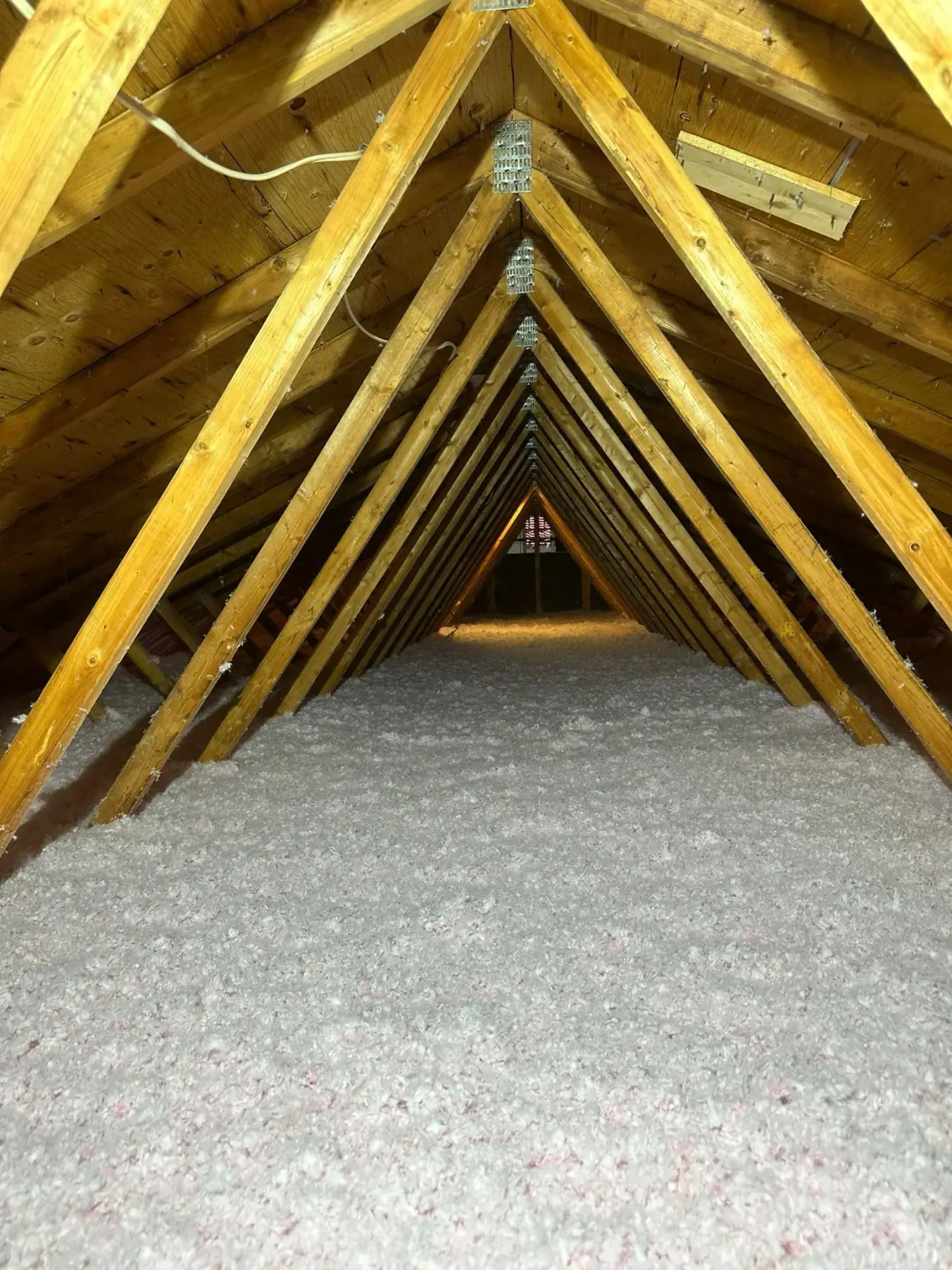
A top-up is enough more often than people expect.
Removing insulation that still works is waste. These are the conditions that let a layer stay, and all of them have to hold, not most of them.
- The material is dry through its full thickness, not just on the surface, and no roof leak has been reported over that area.
- There is no staining or growth on the underside of the roof deck or on the framing.
- There is no sign of animal activity: no droppings, no tunnelling, no nesting material, no odour.
- The layer is still loose and lofted rather than compressed into a mat that no longer holds air.
- The ceiling plane underneath can still be reached for sealing, or it has already been sealed.
- The intake path at the eaves is clear, or it can be reopened without stripping the attic.
When all six hold, new material goes over the existing layer. See how a top-up is carried out.
The other side of the call
What makes removal the only honest answer
It has been wet
Soaked fibre loses its loft, and loft is what holds the still air that insulates. It rarely comes back, and it keeps the framing damp while it tries.
Growth on the deck or the framing
Those surfaces have to be reachable to be treated. Adding depth over growth seals it in and removes the only chance to correct it without opening the attic again.
It has been occupied
Droppings, nesting material and tunnelling mean the layer is contaminated, and the odour that draws animals back is in it. Extraction runs under containment, and the entry points get traced at the same time.
It is crushed
Decades of settling, foot traffic and stored boxes compress fibre into a mat. A mat has depth on a ruler and little resistance to heat, and anything laid on top inherits that base.
Something has to happen underneath
Rewiring, a ceiling repair, ductwork or a full correction at the eaves all need the deck clear. Doing them afterward means disturbing the layer you just paid for.
The material cannot be identified
Loose granular material of unknown origin is not something to disturb on a guess. Nothing moves until a qualified third party has identified it, and we will name that step rather than work around it.
Any one of those is enough on its own. See how extraction and cleanup are carried out.
How the call is confirmed
The attic gets walked.Not judged from the hatch.
Almost everything that decides this is visible to someone who knows where to look. What gets checked:
- Depth at several points, because attics are never uniform and the thinnest area is what the room below reports.
- Moisture through the full thickness, not on the surface, where it dries first and reads clean.
- The underside of the roof deck, where the staining pattern separates a roof leak from condensation.
- The soffit intake, and whether baffles exist to hold that channel open once insulation is added.
- The ceiling plane: hatch, bath fan housings, recessed light cans, plumbing stacks, interior wall plates.
- Where bath fans and the dryer actually discharge, because a duct that stops short soaks what is above it.
- Odour, droppings and runs through the layer, traced back to how something got in.
- Photographs, so you see what we saw rather than taking a verdict on faith.
| What we find | What it usually means | Likely path | How it is confirmed |
|---|---|---|---|
| Dry, lofted, simply shallow | The layer still works, there is just not enough of it | Top-up | Depth at several points, moisture through the full thickness |
| Crushed into a dense mat | The fibre no longer holds the still air that does the insulating | Removal, often partial | Depth against joist height, the layer opened by hand in several bays |
| Damp, matted or stained | Water from above, or warm air condensing on the sheathing | Removal of the affected area, then find the source | Staining pattern on the deck, framing checked for damp |
| Droppings, tunnelling or nesting | The attic has been occupied and the material is contaminated | Removal, with containment | Runs and entry points traced to the soffit and roof line |
| Loose granular material of unknown origin | It cannot be identified by eye and must not be disturbed on a guess | Nothing moves until it is identified | Identification by a qualified third party, before any work |
| Insulation packed into the eaves | The soffit intake is blocked and the attic cannot dry | Airflow corrected first, either way | Intake checked inside and out, baffles looked for at every bay |
| Wet patch under a bath fan or duct | Something is discharging into the attic instead of outside | Duct corrected, wet material removed | Terminations traced to the exterior, not to where they leave sight |
Scroll the table sideways on a phone.
The grey zone
What tips a borderline attic one way or the other
Plenty of attics are not clearly one or the other. What decides it then has nothing to do with the insulation itself.
Only part of the attic is affected
A leak over one corner does not condemn the whole space. The affected bays come out, the cause is corrected, and the rest is topped up.
The ceiling has never been sealed
Removal is the one moment when every penetration in the ceiling is reachable. Adding depth over an unsealed ceiling buries that access, and moving air carries heat past any depth you install. Air Sealing.
The airflow path has to be rebuilt
If insulation is packed into the eaves and there are no baffles, the intake has to be reopened before depth is added. When that correction runs the length of the attic, clearing it is often simpler than working around it. Attic Ventilation & Airflow.
There is no attic floor to insulate
A sloped ceiling, a knee wall or a cathedral assembly is not a top-up question at all. There is no room for a vented cavity, so insulation and air barrier have to be the same layer. Spray Foam Insulation.
The cold rooms are not under the attic
If the attic above the complaint already measures well, the wall cavities are the next place to look, and they can be filled without opening the wall. Drill & Fill Insulation.
The roof is being replaced soon
Sequencing matters. Work that disturbs the deck or the eaves is easier to coordinate before new insulation goes down than after.
Choosing what goes back in? Read the R-value and materials guide.
What changes the scope
Why a removal is quoted attic by attic
A removal is not one job with one scope. What moves it is the volume of material coming out, how the attic is reached and how far the hose has to run to the truck, how much of the space is affected rather than all of it, what containment and disposal the condition calls for, and whether ventilation or sealing work has to happen while the deck is clear. That is what a quote has to account for, and square footage alone does not settle it. Request a quote and we will tell you what your address and attic size already settle, and what would move the number.
Removal or top-up
Questions homeowners ask us.
Everything below is about deciding whether the existing insulation stays or goes. Tap one.

Eco-Therma
Usually replies the same day
Does old insulation always have to come out?
No, and taking out material that is still doing its job is waste. Age alone is not the test. What matters is condition: whether the layer is dry through its full thickness, whether it is still lofted rather than crushed, and whether anything has lived in it. A layer that passes all three can usually be topped up.
What happens if you add new insulation over a problem?
The problem keeps going, out of sight, under a fresh layer that now has to be removed too. Damp material stays damp because it is covered, contamination stays where it is, and the ceiling penetrations that were leaking air are buried under the new depth, so sealing them later means opening the attic a second time.
Can only part of the attic be removed?
Yes, and it is common. A roof leak over one corner or a rodent run along one side does not condemn the whole attic. The affected area comes out, the cause is corrected, and the rest is topped up. What decides it is where the evidence stops, which is why the attic is walked rather than judged from the hatch.
How long does the attic stay open?
Most residential attics are completed in a single visit, and a removal adds time for containment, extraction and cleanup before anything new goes in. The assessment establishes the scope before the work is scheduled, so the timeline is set from what is actually up there.
A practical next step
Find out whether yours stays or goes
We will tell you which one your attic needs, and we will say so plainly when the existing insulation is fine where it is.